Feelings, Nothing More Than Feelings


I’ve been thinking a lot lately about the emotions connected to certain brands. I associate Publix, for instance, with a warm, welcoming feeling. Gatorade stirs feelings of empowerment. Apple feels sophisticated and cool. So as a brand champion for Healthy West Orange, I had to ask: “How do I want people to feel about us?”

As a brand that’s barely two years old, there’s tremendous opportunity — as well as responsibility — to shape the feelings evoked by our logo. We’re a small shop without the massive budget or the manpower to launch enormous campaigns like the big kids on the block. But creativity is free, and a strong content plan can free up enough hours to double your productivity.

The feelings I want to link with Healthy West Orange are: helpful; friendly; expert. These words are guideposts for each piece of content I craft, from vision to editing to posting on social media. For instance:

Helpful 

This video was part of a larger campaign to introduce our audience to our mascot, Westly. In addition to “cook” with Westly, I shot and edited “play” and “move.”

Friendly

I have to admit, I love the raw vibe of Buzzfeed content. That was my creative vision for this video. The intent: create a shareable video that would generate positive vibe around the brand.

Expert

Our mission is to become the healthiest community in the nation. It’s going to take a lot of small bites to get there, but it starts when we can influence our audience to abandon unhealthy habits and adopt new ones. That can’t happen if our audience doesn’t trust us.

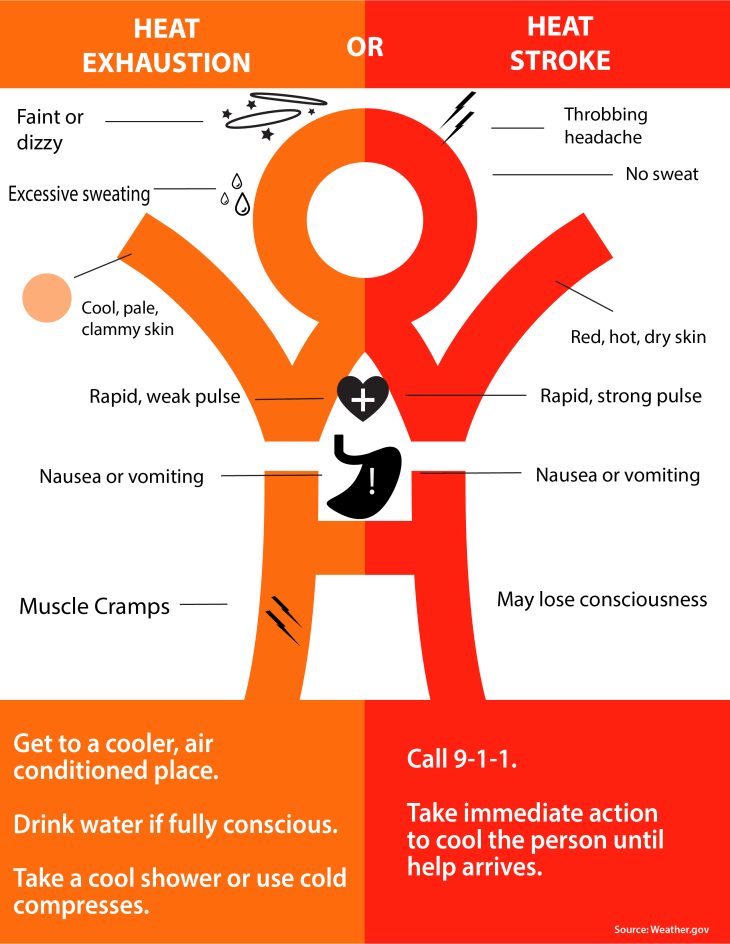
Here’s a graphic I created just this week as part of our heat safety awareness month.

Westly Heat Stroke v2-01.png

Building emotion around brand is not an overnight process. But I’m confident with intentionality and authenticity it can be done.

Launching a Brand

This was an exciting summer for Florida Polytechnic University. The marketing team has been working since January on launching a new logo, look and website. Our finish line was Aug. 1, which meant July was dedicated to generating excitement and educating our audiences about the upcoming changes.

As content strategist, I drafted a comprehensive communications plan built on email, social media and video. Having this all mapped out took some time, but when it was done, all we had to do was plug in the pieces and go.

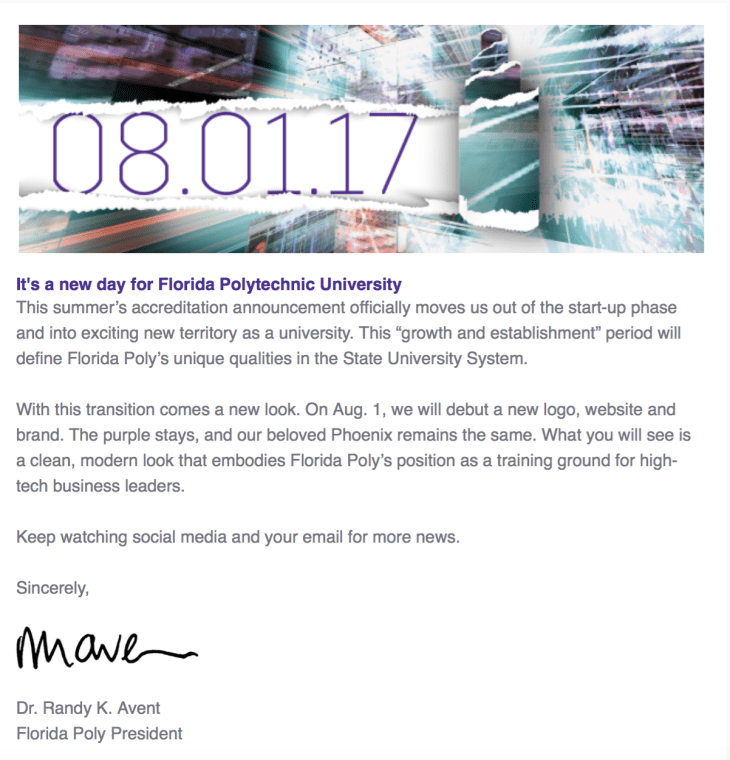
Here is what I wrote for July 12. Our overall message was: “We’re moving into a new period for Florida Poly.”

Email:

Screen Shot 2017-08-12 at 3.13.31 PM.png

Social Media:

Screen Shot 2017-07-18 at 8.18.53 PM.png

It was critically important that our audiences (alumni, parents, Board of Trustees, students, staff and faculty) understood that the new look was coming. But that doesn’t mean we couldn’t balance the serious business of education with a touch of humor.

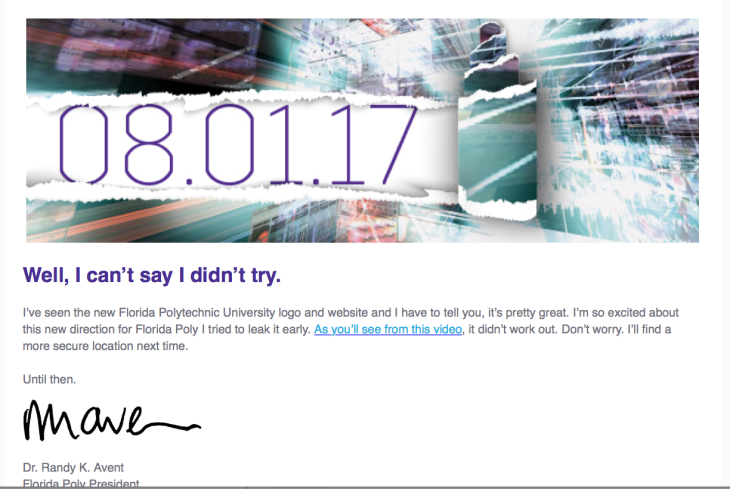
I wrote, produced and edited a series of videos that were sent out by email a few days after our more straightforward emails went out. These fun videos delivered our message, while also showing that the highest authority at the university endorsed the new logo.

Email:

Screen Shot 2017-08-12 at 3.21.18 PM.png

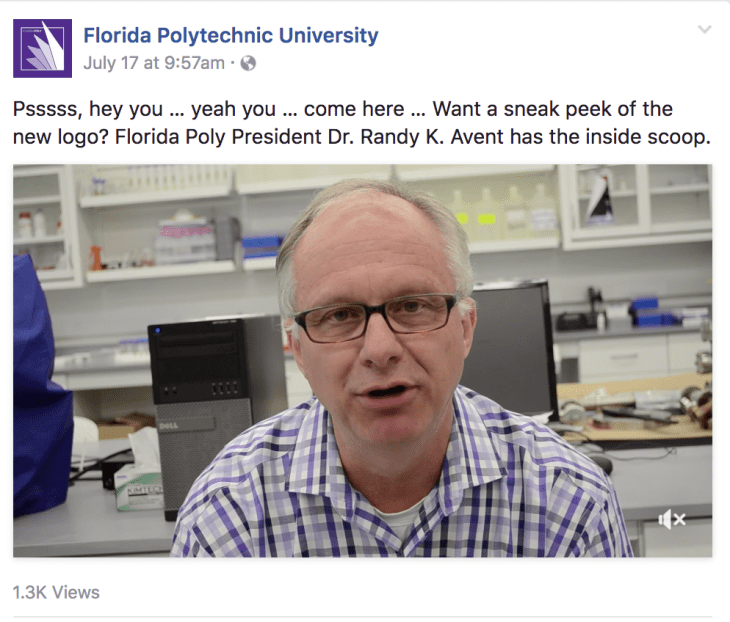
Social Media:

Screen Shot 2017-08-12 at 3.26.50 PM.png

The three videos, documenting our President’s failed attempts to leak the logo:

First Leak

Dr. Avent goes underground

Dr. Avent concedes defeat

All told, the team used six emails, three videos and multiple social media messages to achieve our goal. The end result was a smooth, fun transition from old to new.


Five Ways Journalists Improve Marketing

It’s tough out there for reporters. If they’re not getting blamed for spreading “fake news,” they’re dealing with out-of-touch executives, low wages and poor career futures. That’s why you’re finding more and more reporters leaving the business and going into PR or marketing — like me.

But just because we’re removed from the newsroom doesn’t mean we’re not bringing over the skills that helped our outlets tell stories that matter. Here are five ways hiring a journalist will improve your marketing.

We’re Storytellers

In a world where you have roughly .05 seconds to arrest someone’s scrolling finger, it’s critical your content is compelling. Reporters are masters of developing content that lures you in and keeps you hooked.

Bottom line: A reporter captures audiences.

We Find What Matters

Reporters work a lot of beats, from criminal trials to high school principals. While we have our affinity and specialities for certain beats (I loved the cops and military beat), there’s a reason we can easily switch between beats. At heart, every reporter has the instincts to look at all the different pieces of a story and find the news.

When applied to marketing, that means a reporter can look at a dozen different data streams (focus groups, executive input, market research) and pull together the key pieces.

Bottom line: Reporters bring focus.

We’re Deadline-Driven

On a given day, a reporter is juggling a daily story on deadline, attending an event, editing an existing piece, fielding phone calls and working on a weekend story. And if he or she is lucky, putting in research on a long-term project. It’s a whirlwind environment, but excellent organization and prioritization make it work.

Granted, that’s not all that unusual from other work environments. But reporters easily transition into the deadline-driven world of marketing.

Bottom line: Reporters deliver on time.

We are great interviewers

Listening is an art form. More than just “hearing,” listening is the practice of pushing aside all your responses and just focusing on what someone is saying. A practiced interviewer can go one step further and take notes, anticipate the next question to ask and still provide positive affirmation as the subject talks.

Today I daily do interviews with students and professors for our content. It’s a skill that allows me to not only ask smart questions, but find the story that’s going to tell our brand. (See Point No. 1)

Bottom line: We find truth.

We’re Curious

One of the best pieces of advice I ever received as a cub reporter was “Question everything.” Reporters see the world through a skeptical lens. (Sometimes a cynical lens, I’ll admit.) Give us a process or procedure and we’ll ask you why it’s done that way. Show us the latest market research or trend and we’ll poke at it until see why it works or doesn’t work.

This propensity for questioning can lead to some big ideas and revolutionary thinking in an industry where the only constant is change.

Bottom line: We inspire change.

Utilizing Assets: An American History Guide to Jargon

Jargon crops up in just about every workplace. I define it as the filler words that creep into sentences when the writer either wants to sound important or cannot succinctly make their point.

As an editor, jargon is as much a target for my red pen as misspelling and grammar. I learned a lot about converting jargon to plain language as a police reporter, when I had to convert “responding to a residence” to “going to a house.” The problem with jargon is that it robs a sentence of meaning and clouds it with a lot of unnecessary words. To illustrate, here are some famous American history quotes rewritten using some of the common jargon I weed out on a daily basis.

‘Giving 110 Percent’

“America was not built on fear. America was built on courage, on imagination and an unbeatable determination to do the job at hand.”
-U.S. President Harry Truman

WITH JARGON

“Fear is not the foundation of the country in which we live. Instead, America’s core competencies include courage, imagination and giving 110 percent to complete its tasks.”

‘Leverage Assets’

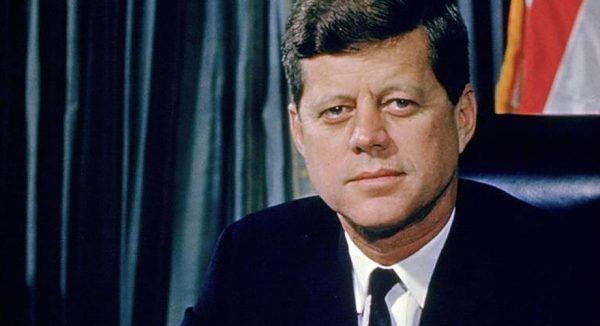
“And so, my fellow Americans: ask not what your country can do for you – ask what you can do for your country.”
-U.S. President John F. Kennedy

      WITH JARGON

“To truly gain a robust relationship with America, don’t request the country leverage its assets for your benefit, but synergize and utilize your assets for the country’s benefit.”

‘Best Practices’

“I have learned over the years that when one’s mind is made up, this diminishes fear; knowing what must be done does away with fear. ”
—Rosa Parks

WITH JARGON

“One of the best practices I’ve discovered to drill down on fear is to create clear objectives. Understanding the task at hand removes fear.”

‘Near Future’

“I have a dream that my four little children will one day live in a nation where they will not be judged by the color of their skin but by the content of their character.”
-Dr. Martin Luther King Jr.

WITH JARGON

“My vision is that at some point in the near future we can get the ball rolling and my four children will reside in a nation in which they will be judged by the content of their character, not the color of their skin.”

‘Deliverables’

“I know not what course others may take; but as for me, give me liberty or give me death.”
-Patrick Henry

WITH JARGON

“Moving forward, I’m not certain what actionable items others are considering. But my deliverables can only be liberty or death.”


False Start: Why Journalists Fumbled Cam’s Interview

Carolina Panthers quarterback Cam Newton drew a lot of flak last week for his post-Super Bowl interview. Many talking heads were quick to criticize his short answers and abrupt departure from the press conference. Others, myself included, excuse Cam’s behavior as the natural response of a hyper-competitive athlete who just lost the biggest game of his career (to date).

Regardless of which camp you fall into, all journalists will benefit from reviewing the tape, so to speak, of Cam’s interview. Because if you ask questions for a living, you’re guaranteed to come across a hostile and difficult interview like this one. Walking away from these interviews with anything useful is going to take a special effort. With that in mind, here’s my Monday morning quarterback review of how I would have handled this interview.

Assess the Situation

This seems obvious, but it’s important to formulating a strategy. Interviews are a chess game with no fixed rules, so you need to be nimble. Cam’s slouched posture, his apathetic expression and shrugs all signal he has zero desire to be in this interview. If you’re on the other side of the podium, you need to immediately decide your next move. There’s no quick answer to this one and most often it comes down to a judgment call based on your experience.

In this instance, I would go with cutting the interview short. I’d pick two or three of my most important questions and ignore my questions about turf conditions or whether he planned to do any sightseeing in San Francisco before heading home. The longer you drag it out, the worse it’s going to get.

Sometimes that’s not the best move. In this case I wouldn’t label Cam “hostile,” just difficult. Public officials under pressure (say, the mayor answering questions about kickbacks or a sex scandal) can get hostile and throw snide jibes about “the media.” In that instance, I would hold an elected official’s feet to the fire and barrage him with questions. Who knows. He might just slip up and depart from the canned responses.

Ask Meaningful Questions

Bad questions in a difficult interview are usually the result of two things: awkwardness and pressure.

The pressure is usually built-in because big stories are the most common source of difficult interviews. Your source doesn’t give a rip about your deadline, though. They don’t care your editor is expecting you to file a front page story chock-full of details. They just want to be gone. So when the interview starts going off the rails, the pressure leads to panic, which leads to sloppy questions.

It also gets awkward really fast in a difficult interview, at least on your end. Like, open fly in a business presentation awkward. Interviews depend on a give-and-take formula to work, so you’re left with nothing when the validation dries up. Looking back at the interview with Cam, you can sense some of the desperation when the reporters start stating non-questions like these gems:

“I know you’re disappointed not just for yourself but your teammates. You guys talked about being a band of brothers coming in. It’s got to be real tough.”

“Obviously you’re disappointed…you’ve played some tremendous games and had some tough losses too. Being on this big a stage…it’s difficult I know.”

Cam doesn’t even verbally acknowledge that last one. He just gives a look and a nod like “obviously.”

To be fair, some of the reporters asked some really good questions. I liked “Anything in particular that was memorable?” and “Can you put your disappointment in words?” Cam’s lackluster responses are not the reporter’s fault.

The lesson here is don’t panic, detach yourself from your feelings and stick to your list of questions.

Experience Pays Off

Experience is going to be your lifeline in a difficult interview. The more you go through, the better you’ll be at handling them. But for the rookies out there, here’s a piece of encouragement. Even the pros can get flustered from time to time.

Shakespeare’s Guide To Improving Blog Headlines

ShakespeareI think William Shakespeare would have thrived as a blogger. His snarky sense of humor and exceptional wordplay are key ingredients to writing shareable articles.

But even a master like Shakespeare would get lost in the blogosphere without a good headline.

Most people, including myself, have an online attention span equal to a cat in a roomful of laser pointers. The only thing that stops my scrolling thumb is a compelling photo or a strong headline.

Digital content experts are quite aware of this and have analyzed our online behavior to identify the types of headlines that snap us out of our browsing fugue. To illustrate, I’ve applied six of these headlines to Shakespeare’s works.  

The List Headline

10 Things Your Apothecary Isn’t Telling You
from Romeo and Juliet

The reporter in me hates the phrase “win-win,” but list articles really are close to perfect for both the writer and audience. Their basic structure makes them easy to write and they appeal to our basic need for order and patterns.

The How To Headline

How To Alienate Friends and Topple a Monarchy
from Hamlet

Honestly, most “how to” articles I read are not ones I was looking for. A strong headline reels you in and suddenly you’re reading “How to Pickle Cantaloupes.”

The Facts and Tidbits Headline

Why 95% of Spot Cleaners Don’t Work
from Macbeth

Bite-size pieces of information are the true currency of social media. They’re easily shareable and great for buying acceptance around the water cooler. Set them up for success with one of these headlines.

The Upcoming Trends Headline

Donkey Heads Next Big Thing: Fashion Insiders
from A Midsummer Night’s Dream

No one likes to feel left out. A strong prediction headline and its accompanying article appeals to the emotional need to be a part of something bigger.

The Secret Wish Headline

The Real Reason You Missed That Promotion
from Othello

These headlines play to our deepest, unadmitted insecurities. Think about what keeps your target audience up at night and write a headline that taps into it.

The Worst and Best Headline

The Best Knives For Carving a Pound of Flesh
from The Merchant of Venice

Life hacks are a huge trend and worst/best headlines serve them up with ease. These headlines ask the question: Don’t you deserve the best? And, conversely: Why would you waste your time and money on the worst of something?


Better Writing is Just a Green Day Song Away

Active voice is one of the best ways to tighten up your writing. It immediately makes your point clear to the reader without extra words and gives your writing a professional polish. But what exactly is the difference between active and passive voice? I’ll be honest. This took me a long time to figure out, and it’s something I continue to catch and correct in my writing.

The most basic definition of active voice is that the subject in the sentence takes the action instead of the other way around. It’s the difference between “The dog bit the boy” (active) and “The boy was bitten by the dog” (passive). The challenge is that active voice is not always that simple. For example, “The boy was bitten” looks at face value like it could be active, but it’s actually passive because there’s no source for the biting. It could be anything from an agitated hamster to a wolverine.

To illustrate, I’m going to draw on another age-old writing tradition: show don’t tell. And to do that, I’m going to use lines from famous songs. Seeing these lyrics flipped around might screw with your head a little bit if you enjoy these songs as much as I do.

Here’s what it looks like when you take active voice and switch it around to passive voice. The original lyrics are listed first.

Active to Passive

Michael Jackson’s “Billie Jean”

Active voice:
People always told me, be careful of what you do. Don’t go around breaking young girls’ hearts.
Passive voice:
Be careful of what you do, people always told me. Breaking young girl’s hearts is not something you should do.

Green Day’s “When I Come Around”

Active Voice: I heard you crying loud, all the way across town.
Passive Voice: All the way across town, I could hear you crying loud.

Journey’s “Don’t Stop Believin’”

Active voice:
Just a small town girl, livin’ in a lonely world.
Passive voice:
Living in a lonely world this small town girl is.

Ray Charles’ “I’ve got a woman”

Active voice:
I’ve got a woman, way over town, who’s good to me.
Passive voice:
There is a woman way over town that I have.

Now let’s switch it around and convert passive voice to active voice. The original lyrics are listed first.

Passive to Active

Queen’s “We Are the Champions”

Passive voice: And bad mistakes, I’ve made a few.
Active voice: I’ve made a few bad mistakes.

Red Hot Chili Peppers’ “Under the Bridge”

Passive Voice: Under the bridge downtown, I could not get enough.
Active Voice: I could not get enough under the downtown bridge.

Radiohead’s “Creep”

Passive Voice: When you were here before, couldn’t look you in the eye.
Active Voice: I couldn’t look you in the eye when you were here before.

House of Pain’s “Jump Around”

Passive Voice: And just like the prodigal son I’ve returned.
Active Voice: I’ve returned just like the prodigal son.

As you can see, there is a time and a place for passive voice. It can catch the eye and pack a punch in ways unimaginable to active voice. But, by and large, active voice will always be your best bet for writing tighter and clearer.

Here are some links if you want to learn more:

http://writingcenter.unc.edu/handouts/passive-voice/

http://www.grammarly.com/blog/2014/a-scary-easy-way-to-help-you-find-passive-voice/

https://owl.english.purdue.edu/owl/owlprint/539/


5 Ways to Maximize Your Interview

A key component of creating great content comes from the interview. This is where you’re going to gain the building blocks of your project and the creative direction you need. Nail it and you can move forward with confidence. Blow it and you’re going to flounder.


My background is in newspapers, so my experience with interviews started with the traditional back-and-forth, Frost/Nixon, Barbara Walters-style conversation you picture when you think of news. The setting, though, was often untraditional. I’ve interviewed people through kitchen windows, in hospital rooms, on firing ranges, beside the wreckage of a plane crash, in the smoke of a brush fire and beside crime scene tape, just to name a few.

I didn’t come across many courtroom dramas when I transitioned to marketing, but the interview skills I had developed were just as handy. I used them first to craft stories for digital and print mediums, as well as videos. Other times, especially as a consultant, a good interview gives me a better picture of how the client wants their brand portrayed. This is the foundation and starting point of creative content that will tell a brand’s narrative and develop an emotional connection between the brand and consumers.


Here are five tips to make your next interview a success.

Warm Up Your Subject

Your interview does not begin when you start taking notes. It starts with the first impression you make on the doorstep or when you first walk into a meeting. Move with confidence and keep the conversation going. If you’re in an office or home, pick out a photo, trophy or souvenir and ask about it. Or, if you’ve done your homework (think LinkedIn, a phone call to an associate), you’ve come equipped with some background on your subject’s hometown or hobbies.

This serves two purposes. First, it gives your subject some easy and familiar questions to answer and, consequently, puts them more at ease. Secondly, it helps them trust you, which is crucial if you’re going to get a good quote and an impactful story.

Do Your Homework

At their core, interviews are really about uncovering someone’s perspective and opinion. The more you can set aside your bias and understand your subject’s world view, the better your interview will be.

That’s a heavy concept, so let me put it in more practical terms. Some of the most powerful interviews I’ve done are with veterans who survived the Pearl Harbor attack. I’ve never served in the military, much less experienced combat or even been to Hawaii. I can, however, look up details of the attack and talk in broad terms about Schofield Barracks, Oahu and the morning of Dec. 7, 1941. Repeating that knowledge demonstrates that you care about the subject and will help you go into an interview prepared to understand your subject.

Shut Up

As much as you want to show off your newfound knowledge, the interview is not about you. Your job is to supply the questions, then listen attentively and take notes.

One way I avoid interrupting the subject is to write down a question mark or star next to an interesting quote or statement. This will satisfy the urge to interrupt and keep you from forgetting a follow-up question.

Ask Open-Ended Questions

Does anyone else cringe when an interviewer asks, “So, how did that make you feel?” There is a time and a place for closed questions. For example, “what is your final deadline?” More often, though, you want open-ended questions. One of my favorite opening questions is, “Tell me about…” This allows the interviewee to pick what’s most important to them and gives you home court advantage.

Ask the Obvious Question

Even with the best preparation, you’re not going to be an expert in the subject. That’s why you’re interviewing this person. So if something comes up you don’t understand, don’t hesitate to ask. Don’t ask so often that you come across as completely unprepared. But frame it like, “I’m sorry, can you help me understand what means?” Most interviewees will be happy to help.